
Advertising
Break even ROAS: why 2.5 becomes 3.33 on a $100 order
Your dashboard says each ad dollar brought in three dollars.
Finance says those orders barely covered the money it took to ship and replace them.
Compute break even ROAS from the contribution an order leaves before ad spend, using comparable revenue and cost numbers.
ClassMaster · Updated
Which numbers belong in the formula?
Start with the dollars the business actually kept after discounts and refunds.
Subtract product cost, payment processing, packaging, fulfillment and any variable service cost, and account for returned
items consistently.
The remainder is available for advertising and contribution toward fixed costs and profit.
Break-even ROAS equals net revenue divided by pre-ad contribution.
Equivalently, divide one by the pre-ad contribution margin as a decimal.
Use the same revenue definition in the ROAS being compared.
If your dashboard reports gross order value, reconcile it to the net dollars used in your target before making a spending
choice.
What does that look like on a $100 order?
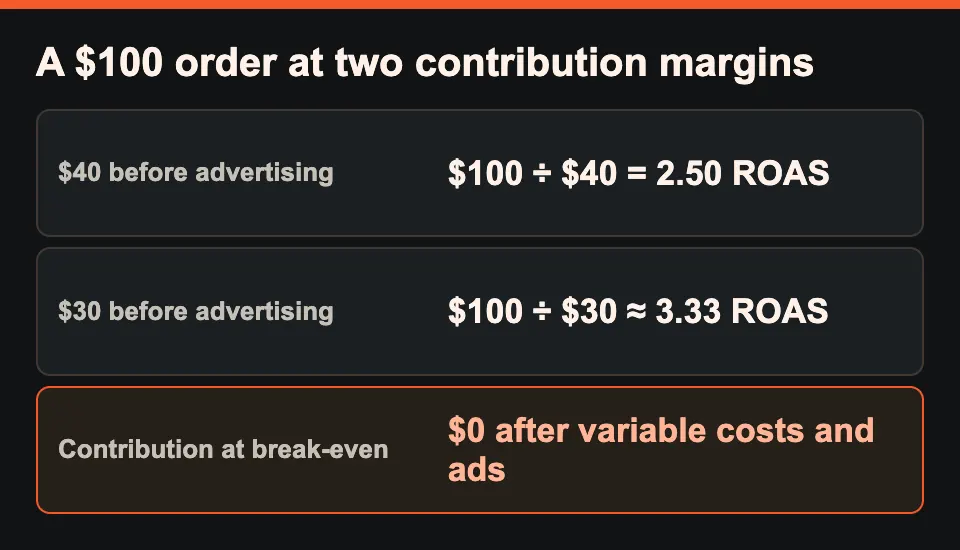
Suppose ten orders average $100 after discounts. Across those orders, payment fees, goods and delivery average $60 each.
Contribution before ads is $40 per order.
On those assumptions, break-even ROAS before fixed overhead is $100 divided by $40, or 2.5.
If discounts and return adjustments raise effective variable cost to $70 on the same revenue base, $30 remains and the
required ROAS becomes about 3.33.
Both figures use simplified illustrative costs. Your actual receipt and inventory data may have other items.
- Compare net sales from the same orders.
- Allocate return-related recovery and cost consistently.
- Treat ad spend as the amount that contribution can cover.
Do a single-product calculation
Put net sales, variable cost and ad spend from the same completed order cohort on three lines.
Divide net sales by the amount left before ads. That is the break-even revenue ROAS for that cohort before fixed overhead.
How should refunds be included without double counting?
Suppose one order is refunded but the item comes back ready to resell.
Refunds reduce the original revenue, and the returned stock may recover part of its product cost.
Your accounting treatment should capture both without deducting the same amount twice.
A buyer who never completes payment is not net revenue.
A refund issued next month can still belong to the campaign's earlier order cohort. Decide how long to let orders mature.
Compare cohorts at similar ages so the newest ad period doesn't look stronger simply because returns haven't arrived yet.
Why can a campaign beat the target and still disappoint?
Campaigns can mix products with very different margins.
If one ad moves a low-margin bundle, the overall ROAS may look healthy while that product uses all its pre-ad contribution.
Separate core products from add-ons or upgrades before deciding what to scale.
Channel reporting can credit the same purchase to more than one ad or tool.
Keep an agreed source definition for campaign analysis and a separate record of company-wide results.
Before changing a budget, check whether the verified profit pool grew and whether the winning campaign brought in the kind of
customers you expected.
How much room should your target leave?
A break-even number tells you where a particular order cohort covers its variable costs and ad spend.
It leaves zero contribution for overhead or profit.
If you want $10 left on the $100 order with $40 pre-ad contribution, your allowable ad cost is $30.
Your operating target then becomes 3.33 ROAS at the same revenue definition.
A store can intentionally invest more to acquire a first-time customer if repeated purchases are genuinely measured.
Judge that decision on actual customer retention and contribution over a defined time.
A hoped-for second purchase is a scenario, which should sit beside the observed first-order result.
What does this tell you about your next advertising decision?
Build low, realistic and high return-rate cases using the same product mix.
If the observed net ROAS falls below even the optimistic target, inspect the order and offer economics before adding budget.
If it exceeds the cautious target, look at how much spend and how many orders support that result.
ClassMaster can help connect an ad report to net orders and WhatsApp follow-ups.
Share an anonymized set of sales, variable costs and ad spend from one period, then use that to see which number your team
should track during the next test.
Use a second threshold when staff capacity matters
Two campaigns can clear the same break-even ROAS and still compete for the same fulfilment slot.
Suppose one attracts standard online orders while the other needs manual quotes.
If the second campaign needs paid overtime for each quote, recalculate its contribution margin on the orders you actually
fulfil.
Run both thresholds before choosing which budget to expand.
If paid orders come in later, give each campaign the same time to mature before comparing them.
Compare product mixes before using one target for the whole account
Suppose an online store runs two advertisements at the same spending level, one for a standard product and one for a bulky
accessory.
Each group brings in $1,000 of attributable revenue after refunds and costs $300 in ads. Both report 3.33 ROAS.
If the standard product retains $460 after variable costs and the bulky item retains $270, the first group has $160 left after
ads and the second is $30 short.
The product mix changes the decision even though the same reported return appears in both columns.
Check whether postage and handling are already in product margin before making this comparison.
An order-level example can reveal a shared fulfilment fee that accounting included under handling and the store owner planned
to remove again.
Put its invoice in one line and state whether your numbers include the cost of returned items.
The calculation is most useful when the next person looking at it knows where each component came from.
Check realistic variations before raising a budget
Use a coarse range when the margin could move.
If you expect more returns on a new product, estimate what a few additional refunds would do to contribution using the same
time period.
Check whether the price that buyers actually pay changes when coming from the promotion.
A campaign reaching more distant ZIP codes could have the same selling price and a different share of shipping fees.
A sound weekly review can note the change and choose a second period to see whether it is persistent.
When deciding how to allocate next week's spend, write down the risk the business can handle.
Spending more at break-even creates more orders but still leaves no contribution towards fixed overhead under the assumptions.
A small buffer also gives staff a useful rule for pausing if refunds lag.
Sources · 2026-11-28 · Meta for Business · ClassMaster acquisition
Related guides
FAQ
Is break even ROAS the same as profit?
It shows what event-level revenue must cover for this calculation. Fixed overhead and desired profit have to be added to the business decision.
Do I use margin or markup?
Use contribution margin on net revenue after variable costs. Markup is measured against cost and gives a different number.
What if I only have platform-reported sales?
Reconcile a sample to actual paid orders and refunds. Keep reported and verified revenue separately while you resolve the difference.
Can I use a separate target per product?
Yes. Group items with similar economics. Compare a campaign's mix with what the target assumes.
What can ClassMaster help calculate?
Share one anonymized product or campaign cohort. We can review the margin assumptions and which conversions belong in the comparison.