
WhatsApp AI
WhatsApp Business API pricing: 300 vs. 5,000 inquiries
A provider tells you its inbox costs one amount.
Your finance lead sees a Meta charge on another statement and wants to know what changes when campaigns pick up.
Estimate delivered messages for each number and recipient market, then add the provider and implementation costs on separate
lines.
ClassMaster · Updated
What does the North America rate card actually price?
Meta's USD rate card effective October 1, 2026 lists $0.0250 for marketing and $0.0034 each for utility, authentication and
service at North America list rates.
These are rates for eligible delivered messages, not quotes from a vendor.
Charges can differ with recipient market, eligibility and applicable tiers.
A US merchant can get inquiries from more than one pricing region.
Use the actual recipient route in your delivery report before applying a rate.
Take extra care with shared international country codes.
Use Meta's country-calling-code mapping and the market in your account report, rather than assuming every message a US number
sends gets the same price.
How do you turn 300 inquiries into a message estimate?
Suppose an outdoor equipment retailer gets 300 inbound conversations.
Its team sends two ordinary service replies per inquiry on average.
It separately sends 180 chargeable order notices and 100 marketing messages.
For one eligible number, 600 service replies fall within the 1,000-message monthly allowance in the example.
At North America list rates and without other qualifying free entries, the utility and marketing examples cost $0.61 and
$2.50, or about $3.11 in Meta fees.
These assumptions treat the utility templates as chargeable.
The ordinary customer service window alone does not make a utility template free.
- Inbound customer questions are separate from your delivered message counts.
- A buyer can ask two questions inside the same inquiry.
- A campaign recipient is not necessarily a delivered recipient.
Build a one-number estimate
Take one completed month. Use one line each for chargeable marketing, utility, authentication and service.
Flag messages delivered through a qualifying free entry point. Add platform and onboarding in separate columns.
What changes at 1,000 or 5,000 inquiries?
Keep the same two service replies per inquiry and one chargeable utility message per inquiry.
With 1,000 inquiries, 1,000 service replies remain after the allowance in this example.
Utility and service add $6.80 before marketing.
At 5,000 inquiries, 9,000 service replies remain and the combined example comes to $47.60.
If five stores share one sender, keep the shared allowance visible.
If each store has its own sender, apply the rule to each separately.
The difference is worth checking before redesigning a number setup.
Do that calculation in the context of staffing, access and customer experience.
Which costs are absent from this estimate?
A vendor can charge for seats, active contacts, extra numbers or message processing.
Ask whether seats are named or shared, and whether two part-time agents count twice.
Ask for the charge that applies when a person sends a message the inbox handles and when your business sends one.
Setup can include connection work, template approval support, building flows, testing with staff and making an integration
handoff.
Name what each quote includes.
When one proposal has business onboarding and the other assumes you do it, a comparison of monthly prices hides real staff
work.
When do free windows affect the calculation?
Record whether a recipient launched a qualifying click-to-WhatsApp interaction or came from a different source.
Meta's documentation says an eligible mobile click-to-WhatsApp message and an in-window business reply can open a free entry
point for up to seven days.
Meta Business Agent usage remains billable. A click count cannot identify eligible delivered messages on its own.
Ask the person responsible for ads and the person responsible for messaging to reconcile the same conversation sample.
The source that gets recorded in your CRM may differ from the evidence Meta uses for billing.
Add those identifiers to separate columns if necessary.
What should a manager see before a renewal?
Show ordinary month, campaign month and first month. Use the same number count and delivered-message mix for every bid.
Include whether your team still needs to write answers, maintain transfers, investigate errors and fix incorrect stock
information.
If two offers are close, test a real conversation in each.
Find out how many minutes the next employee spends discovering what was agreed.
A plan only saves that work when the summary and next action are in the place your employee actually uses.
Compare the three volumes using the same mix
To compare scale on a like-for-like basis, assume two delivered service replies and one chargeable utility template per
inquiry, all to numbers in North America.
Use one business number and set marketing aside.
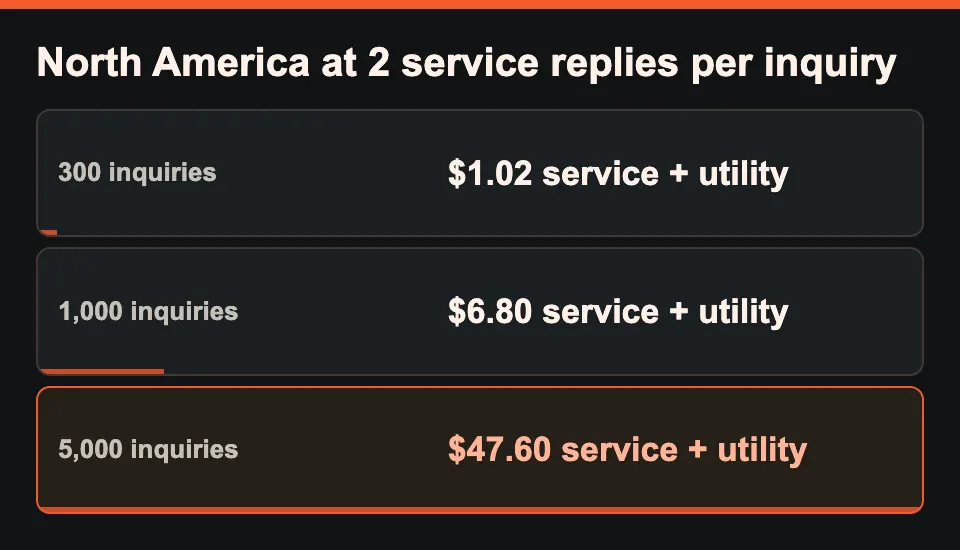
At 300 inquiries, 600 service replies are covered by the monthly allowance and 300 utility messages cost $1.02.
At 1,000 inquiries, 1,000 of 2,000 service replies are chargeable alongside 1,000 utility messages. That totals $6.80.
At 5,000 inquiries, 9,000 service replies and 5,000 utility messages are chargeable, a total of $47.60.
These figures show the service and utility subtotal.
Add marketing, special authentication charges where applicable, and provider costs on separate lines.
The useful detail is where the calculation changes shape.
At two service replies per inquiry, the 1,000 free service messages cover the first 500 inquiries in this simplified scenario.
The next inquiry adds a service cost as well as utility.
This matters if a provider compares the total from a quiet period with a forecast that assumes the same per-inquiry price
during a promotion.
Ask for the underlying assumptions and recompute with the busiest week that actually happened.
Validate the invoice against a case with refunds or rescheduling
A small retailer may need several messages when a carrier changes a delivery date.
Read one order from the first notification through the new date and the refund, if any.
Count messages from the store independently of customer replies.
Mark any free-entry message already identified in billing events so it is counted correctly once.
Then compare delivery and category with the provider’s export. Use that exercise to identify a mismatch before changing plans.
For budgeting, show who can investigate if next month produces a different total.
A manager may need access to template names, delivered status, country code and billing category, while the supplier may
control the export.
Request a sample with only the fields you need.
Write down how seat counts, message fees, and currency are shown on separate invoices.
That gives you a way to compare figures when one part of the stack changes.
Sources · 2026-11-28 · Meta WhatsApp pricing · Meta rate card (October 2026 USD)
Related guides
FAQ
Does every WhatsApp customer message cost us money?
Count incoming and delivered business messages separately. Apply the rate by category, free window and allowance.
Does an official partner include Meta fees?
Check the quotation. Ask whether the partner passes through Meta charges, adds per-message handling, or charges another amount for a monthly allowance.
Can a US business use the same rates for international customers?
Use Meta's recipient market rules. The number you use to send is not the sole determinant of the recipient's rate.
How can I compare my launch to a busy month?
Keep your normal month numbers and add an explicit campaign block with expected delivered marketing messages, peak support load and temporary staff seats.
Which numbers should I send ClassMaster?
Share message totals grouped by category and number, plus how many people handle inquiries. We can review which costs move when volume or team size changes.