
WhatsApp AI
WhatsApp chatbot: which of 48 chats should staff answer?
Your shop can answer “Are you open?” all day.
The inquiry that turns into work is “Can I get this exact part by Friday?” Start the chatbot with one type of inquiry, let it
ask for the missing detail, and give a colleague the rest.
ClassMaster · Updated
What should the chatbot actually do first?
Pick a task that ends in an observable action. A paint store wants to know which product and quantity the buyer needs.
An event rental company needs a date, ZIP code and type of setup before a quote.
These tasks are easy to inspect because a colleague knows if the next step is possible.
A useful system remembers what has already been stated.
If the customer already named the product, the automated reply asks about availability or delivery rather than asking them to
identify it again.
Give the conversation one job at a time. Too many questions up front turn a quick inquiry into a form.
Which questions deserve a direct answer?
Start with confirmed hours, service area, supported products and simple published price rules.
Ask the owner of those answers for the last date checked.
If the chatbot cannot verify a stock count or next-day dispatch, it can explain what it needs and refer the specific request
to the right person.
An answer may be technically accurate but unusable.
“We deliver locally” does not tell a buyer whether the company's installation crew serves their ZIP code.
Write a result the staff member could stand behind.
Decide how the system behaves when the answer depends on the delivery date or item.
Try one real question
Take three anonymized examples from the last week.
Mark what should be answered, which field should be collected and when an employee needs to verify an exception.
Ask a teammate to use the result.
When should it stop and let an employee act?
Use a return request as a test.
The chatbot can note the order number and the item issue, then tell the customer when a colleague can review it.
Price changes, credits and special deadlines should go to the person authorized to make the decision.
Give that employee the latest question, the facts given to the customer and one outstanding decision.
Show whether the customer is waiting on you or owes a detail.
Keep private customer information available only to the people and systems permitted to handle it.
- Acknowledge what the customer sent.
- Summarize the latest request and the last agreed details.
- Assign the person who can take action.
What often goes wrong when a customer changes their mind?
The first message might say blue, but the sixth message asks for a green one.
Some inboxes preserve the whole thread without preserving the current selection in a usable field.
Run a test in which a buyer changes the item and their pickup time.
Check whether a new task was created for the same conversation.
If the contact returns with a different order, keep that as a separate request under the same customer.
A single overwritten product field will otherwise cause trouble.
Train the workflow on two cases that look similar to customers but should create different work for staff.
How can you test in a week without replacing your inbox?
Choose a short test that reflects a normal shift. Use people who do not know the script.
Give one person a vague request, another a product change, and another a service exception.
Compare the actual output with the three answers or handoffs you agreed were correct.
Track how many times a colleague must ask a question a second time.
Measure how often the inquiry has an owner and a next action at shift change.
A drop in missing tasks is a better signal for this test than the total number of automatic replies.
What does a useful next stage look like?
If the initial test shows stable product identification and handoffs, extend the business data a little at a time.
Update stock, price, opening time or pickup rules through the person who owns them.
Decide who can pause a reply when the facts change.
ClassMaster can set up and test a first WhatsApp workflow using your own rules.
Bring one question that often interrupts your team and one that should go straight to a staff member.
That is enough to see whether your first change should focus on the answers or the handover.
Put a numerical stop rule in the pilot
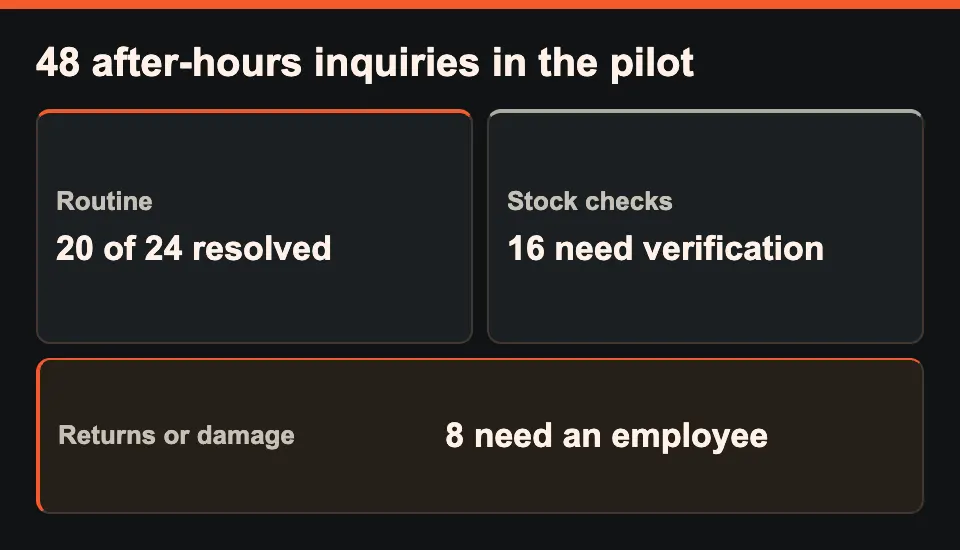
Take a hypothetical home goods store that needs to handle 48 conversations after the floor team leaves.
Twenty-four are routine questions about published opening hours and accepted collection times.
Sixteen require checking a changeable stock position.
Eight concern a return or damaged item and need a decision from an employee.
During a test, twenty of the twenty-four routine inquiries end with a useful answer and four return for the same information.
Automatic resolution is about 83 percent among the routine questions and about 42 percent across all 48 conversations.
It helps to see both figures before adding more automation.
A high reply rate can sit alongside a low resolution rate when the opening answer simply says someone will follow up.
Agree in advance how to identify a resolved inquiry.
For a store, the buyer should have enough verified information to decide where to go and whether the visit is worthwhile.
Acknowledgements belong in a separate measure.
Read a small sample of cases sent to people and ask whether the handoff spared the buyer from explaining the request again.
Read the questions that come back in a different form
Pull five conversations where a buyer asked the same question differently.
A buyer who types “is it really ready today?” may be checking whether a published lead time applies to one particular variant.
If the chatbot repeatedly pulls the generic lead time, give it a way to say what is confirmed and hand the decision to someone
who can reserve the item.
Compare the outcome of those five cases after each significant information change.
The review should also include a customer who shares only part of the information needed.
Give the automated response a short way to ask for the one missing detail.
For example, the name on the model label may let staff identify a part more reliably than collecting an address, a phone
number and a full order history.
Start by testing the smallest question that moves one case towards a helpful result.
Sources · 2026-11-28 · Meta WhatsApp Business Platform · WhatsApp Business Messaging Policy
Related guides
FAQ
Is a chatbot necessary for an away message?
An away message is enough when the business needs to state hours and response timing. Deeper automation is useful when the reply depends on what the customer says next.
Can it quote a price?
It can use a current approved price and conditions. Ask a staff member to handle custom terms, uncertain stock and prices outside the documented rules.
How can we check the handoff quickly?
Have an employee who never saw the test read the note and tell you what they can reply now. If they need to search for basic facts, mark the missing field.
What is a good first metric?
Start with repeated questions or the share of open inquiries with an owner and next action. Choose the one that corresponds to your current problem.
What can I send to ask ClassMaster?
An anonymized exchange, the approved answer, and the one exception that should reach an employee. We can use those to test the first flow.