
WhatsApp AI
WhatsApp API provider: 12 chats to test before you sign
Two providers promise a shared inbox and automation.
At the demo, your employee still has to ask the customer for the address they already sent.
Use one conversation from your business to compare ownership, handover and the cost of changing providers.
ClassMaster · Updated
What belongs to the business from day one?
Ask which company controls the WhatsApp Business Account, the number and the account that approves changes.
Have the provider show the administrator screen in a test environment.
A staff login with permission to answer messages does not by itself give your business access to management settings or
existing templates.
Write the ownership answer down in your purchasing notes.
Store the names of the roles responsible for number verification, business details and offboarding.
A contractor can perform work with agreed permissions while a member of your company keeps ownership.
Ask which functions require the company's own administrator when the provider changes.
Which demo reveals work the feature checklist misses?
Imagine a small furniture dealer with a showroom and a dispatch desk.
A customer confirms pickup on Monday, then asks for delivery to a different ZIP code on Wednesday.
The seller should see the latest address, the exact desk they selected and whether delivery needs a revised quotation.
Ask the provider to give that conversation to another employee who has never seen it.
Time how long that person needs to find the unresolved issue.
A five-minute search repeated across a shift can matter more than a seldom-used extra feature.
Check that the original salesperson does not automatically get both tasks.
- Show the existing customer and last decision.
- Make the system ask for the one item it needs.
- Assign a human task for delivery charges outside the published policy.
Bring this test to each provider
Use three anonymized chats: new inquiry, address change and a refund exception.
Record the responsible employee, remaining task and time to find it for each demo.
Does the provider supply software, implementation or both?
An inbox gives you somewhere to reply.
Implementation turns your branch list, common answers and exceptions into a live process people can use.
Have the provider point out where they stop.
You may still have to update stock, obtain approval for answers, tell colleagues how refunds are checked and review
exceptions.
Write each task beside its owner. A business with two experienced agents may want a clean inbox and integrations.
A solo owner may need someone to configure the first workflow and stay through the first round of corrections.
The value of an implementation partner depends on the work your side would otherwise do.
How do you compare suppliers at the same level of service?
Ask each provider to quote the same number count, seats, active contacts, delivered messages and rollout work.
Request the expected charge after a busy promotion and the cost of adding a second location.
Compare the support period and response arrangement for failures before comparing monthly totals.
A second quote should include your daily message mix and whether you need any existing data connected.
Use a short three-column table: included, staff-owned and billed on request.
If a salesperson cannot name the owner of an exception, the demo should surface it before signing.
What does a safe number transition require?
If you're coming from Business App, check whether your exact setup qualifies for coexistence or another supported route.
If the number already runs on Platform, ask both providers to describe the current migration path.
Check what happens to templates and conversation history in your specific scenario.
Test your real customers' workflow in a sandbox or on a test number first.
Use an employee's phone to simulate an incoming question, an approved outbound template and an order handoff.
Identify which options are reversible and set aside a time when someone is available to handle manual replies.
Which support and exit questions should be answered in writing?
Ask how to export contacts, opt-out information and unresolved work.
Look at a sample export and see if it contains your required columns and stable identifiers.
Request a named contact or support route for message delivery failures and for a billing disagreement.
A good exit plan also states what your team needs from the provider.
If employees cannot own their business records or access a working export, include that cost when choosing.
Start with the smallest workflow you can test before adding the rest.
Compare the providers with a test that can fail
Imagine a repair service covering two counties. It uses the same business number for existing customers and new quotes.
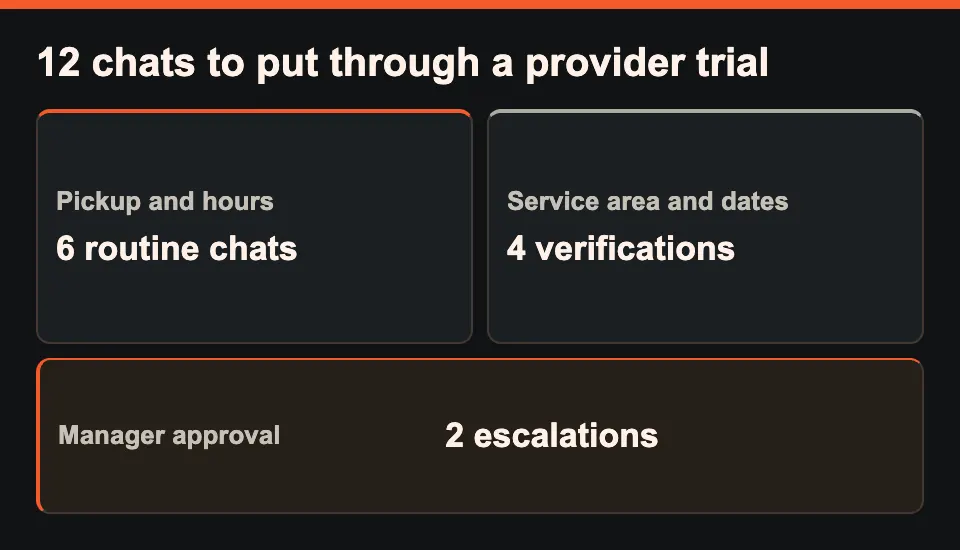
Write twelve conversations for the provider to use in a supervised test.
Six can be simple pickup or opening-hours questions, four require checking a ZIP code and a service date, and two need a
manager to approve an exception.
A platform that receives twelve messages but leaves the exception requests sitting in the default inbox has passed
connectivity.
It has missed a decision the business must make to protect appointments.
Give both providers the same scenarios and the same access to your test information.
Ask the person you expect to cover evenings to continue a case without help from the demo host.
For the four service area checks, note whether the next employee sees both the customer's location and the most recent
promise.
For the two exceptions, record whether only one manager receives the escalation, can accept it, and knows when the customer
should hear back.
Price what the business needs to run after the demo
Review the quote with the person who will actually handle refunds or shift changes.
They may need permission to view earlier activity but will not need full account administration.
Ask which user type they would use and whether the vendor charges for it.
Compare the same number of staff, hours, and conversations if each supplier describes seats differently.
Then ask for a sample export and show where your business can obtain it.
Look for date, conversation source, status, and assigned owner.
If a new team starts a month later, check that exports and account ownership still work without creating a new number.
In an exit discussion, have the provider show what can be taken away, who can remove access, and who keeps the customer-facing
number.
Those details are easier to agree when both parties are still comparing proposals than they are during a busy handover.
Sources · 2026-11-28 · Meta WhatsApp Business Platform · Meta Embedded Signup
Related guides
FAQ
Can we keep our US business number?
Ask the provider to verify the current number type and supported path. Test what data and templates move before setting a cutover date.
What should we bring to a provider demo?
Three anonymized conversations and a simple map of who answers each type. Include one changed request and one case needing human approval.
Is direct Cloud API access cheaper?
Direct access and partner tools have different work requirements. Compare the inbox, maintenance, integration and employee work you would need in each approach.
How do we know whether to buy implementation?
Compare what your team can maintain today with the workflow the provider would deliver. Make it tangible by having someone finish a demo case.
Can ClassMaster look at both proposals?
Share the scope and an anonymized handoff your team struggles with. We can show what to test against the two proposals before deciding.